
Many parents who end up in family court High Wycombe got there because they weren’t aware of other options. That’s not a criticism. It’s just what mediators see time and again. In England and Wales, having a judge decide when you see your child is designed to be the last resort, not the starting point.
If you’re trying to sort out child contact after a separation, the assumption you might be making right now is that if you and your ex can’t agree, the court is where you end up. That assumption is wrong for most families. One of the most practical ways to avoid court for child arrangements in the UK is family mediation: a structured, confidential process that keeps both parents in control of the outcome.
But there’s a question most articles on this topic never answer. What if your ex refuses to engage? Read on, because the answer might surprise you.
Read More on Child Arrangements
Why Most Parents Don’t Need to Go to Court for Child Arrangements ?

The family courts in England and Wales are under significant pressure. Ministry of Justice family court statistics from 2024 put the average time for private law children cases at around 44 weeks from application to final order. That’s almost a year of uncertainty for a child, while two parents who will need to co-parent for the next decade or more are put in direct legal opposition. This guide “Avoid Court Child Arrangements UK” resolves your issues in a breezy way High Wycombe.
The court rules now give non-court dispute resolution a much more visible place in family proceedings. Since the 2024 changes, applicants in cases covered by the MIAM rules must normally attend a MIAM before starting proceedings unless an exemption applies. The court must also consider non-court dispute resolution during the proceedings and can allow time for the parties to pursue it.
Some matters can be settled without a judge making the decision. Parents may be able to agree arrangements for contact, school holidays, communication and special occasions themselves. Mediation gives them a structured setting in which those practical details can be discussed and negotiated. Justice.gov.uk
One thing worth knowing: even where court proceedings do start, a judge can still refer both parents back to mediation at any stage. Starting proceedings doesn’t mean you’re committed to finishing them that way.

💡 WHAT MOST ARTICLES WON’T TELL YOU
A MIAM is a required step for certain applications unless an exemption applies. The meeting itself does not commit you to mediation. The mediator explains the available options, considers whether mediation or another form of non-court dispute resolution may be suitable, and carries out the required safeguarding assessment.
How Mediation Helps You Agree Child Arrangements in Practice ?
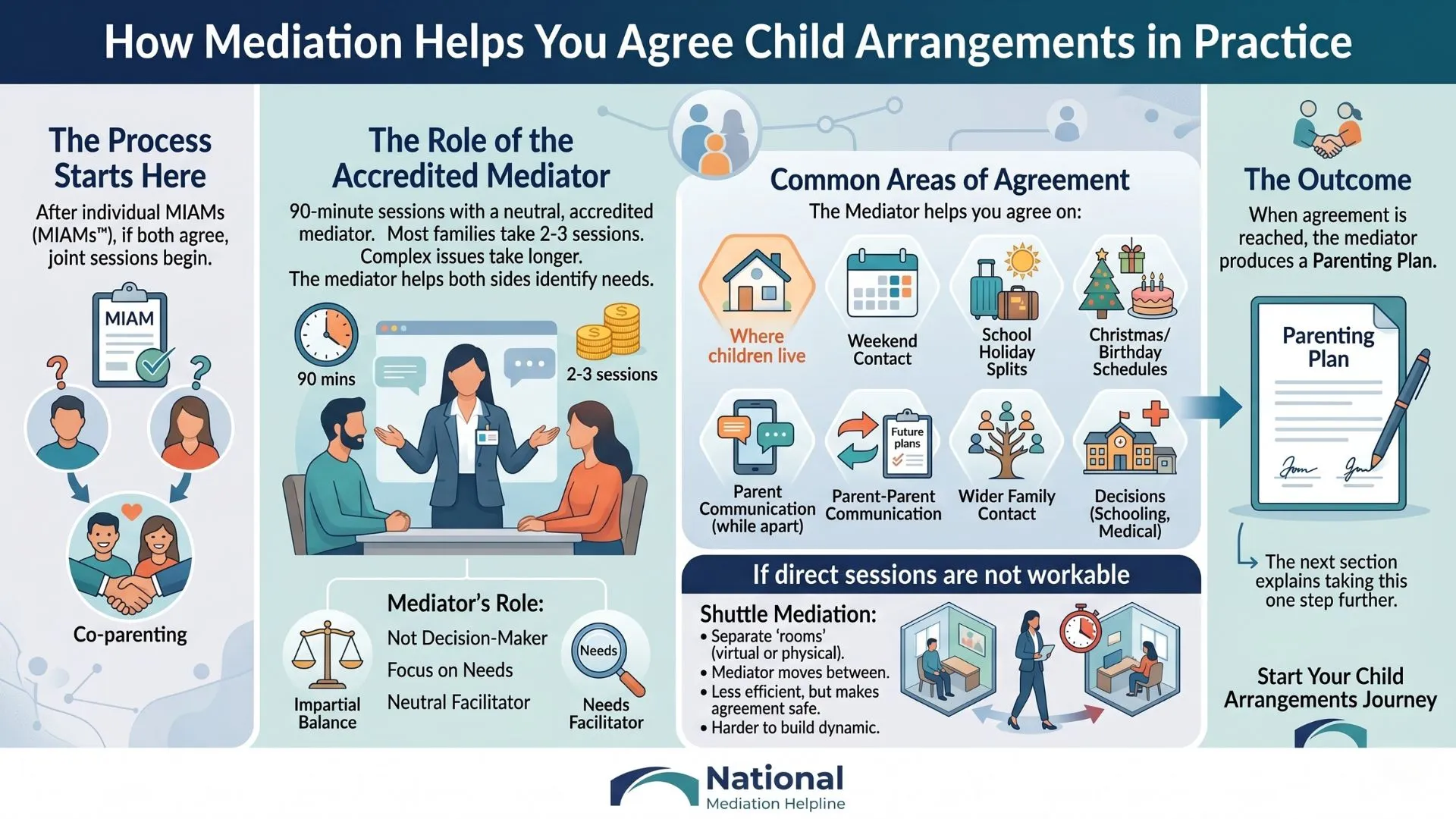
After both parents have attended their individual MIAMs, if both are willing to proceed, mediation moves into joint sessions. These are typically 90 minutes each, with an accredited mediator present throughout. For straightforward child arrangements, most families work through two to three sessions. More complex situations involving multiple issues may take longer.
The mediator {name{ doesn’t make decisions. Their job is to help both parents identify what each of them needs and work toward an agreement that reflects the children’s best interests. They remain neutral throughout the process.
Topics a typical session covers include where the children live during the week, weekend contact, school holiday splits, Christmas and birthday schedules, how each parent communicates with the children when they’re in the other household, and how the two parents will communicate going forward. Decisions about schooling, medical care, and contact with wider family can also be addressed.
Mediation does not always require both people to sit together. Separate meetings can be arranged where appropriate, with the mediator speaking to each person individually. The mediator can then facilitate communication between the parties without requiring them to have a joint discussion.
When both parents reach an agreement, the mediator produces a Parenting Plan: a written document setting out exactly what has been decided. The next section of this article explains why you may want to take that one step further.
| Typical time to resolution | Weeks to a few months | Around 44 weeks on average (MoJ 2024) |
| Indicative cost | Well under £5,000 total for both parents in most cases | Often £15,000 or more per person once legal representation is factored in |
| Who makes the decisions | Both parents, guided by the mediator | A judge |
| Automatically legally binding? | No, requires a consent order if you want enforcement | Yes, by court order |
| Impact on future co-parenting | Tends to preserve the relationship | Often causes lasting damage |
| Can children’s views be included? | Yes, through child-inclusive mediation | Through a Cafcass assessment |
| Government financial support available? | Yes , voucher scheme, ask mediator for details | Court fees apply separately |
What Happens When Your Ex Won’t Engage with Mediation High Wycombe
This is the question every other article about avoiding court for child arrangements in the UK sidesteps. Here’s the honest answer.
If your ex refuses to attend a MIAM, or attends but refuses to participate in mediation sessions, the mediator can certify that mediation has been attempted or that it isn’t suitable to proceed. That certificate is one of the documents you need to make a court application. Their refusal doesn’t trap you. It removes the barrier.
If the prospective respondent is unwilling to attend a MIAM, the person considering the court application should still attend their own MIAM. The mediator can record the attendance and explain what happens next. A prospective respondent is normally expected to attend as well, although the rules provide for circumstances in which that may not happen.
A person may go into a MIAM intending to make a court application, while the meeting itself provides information about mediation and other ways of resolving the dispute. The mediator considers which options may be suitable and explains how they would work. Whether the parties decide to pursue one of those options is ultimately a matter for them.
And if your ex has been legitimately exempted from the MIAM requirement , in cases involving documented domestic abuse or serious safeguarding concerns, for instance, you can proceed directly to court without the mediation step. In those situations, mediation isn’t appropriate, and the process recognises that. A qualified mediator or family solicitor can confirm whether an exemption applies at your first contact with them.
The short version: your ex’s refusal to mediate is not a dead end. It’s a formal, documented step on the way to court if that’s where you end up. Get Useful Insights on Child Access Mediation

HOW NATIONAL MEDIATION HELPLINE CAN HELP
If your ex has refused to engage or you’re genuinely unsure whether mediation is right for your situation, speaking to someone who understands the full range of options can make a real difference at this stage.
The National Mediation Helpline High Wycombe can walk you through what the MIAM process looks like for your specific circumstances and help you work out what to do next. Call NMH or book a free consultation to find out where you stand.
We are Near You High Wycombe
Making Your Agreement Legally Binding High Wycombe: The Step Most Parents Miss

A Parenting Plan High Wycombe from mediation is not automatically enforceable. Either parent can technically depart from it later without formal legal consequences. For families with a reasonably cooperative relationship, that works well enough. For others, it’s not enough.
But here’s what most articles on this topic don’t explain clearly: you can use mediation to reach an agreement and still end up with a court-endorsed order. The two aren’t mutually exclusive.
If you want your mediated agreement to be legally binding, a solicitor drafts a consent order based on your agreed terms. A judge reviews and approves it. From that point, the terms carry the same weight as any court order. If either parent departs from them, formal legal consequences follow. And you’ve got there without going through adversarial contested proceedings.
If you want the agreement to become legally binding, a solicitor can advise you about turning it into a consent order. The agreement reached in mediation is not itself legally binding. A consent order is made by the court and sets out the arrangements that the parties have agreed.
What Court High Wycombe Does to Children: The Reason All of This Matters

When parents are making arrangements after separation, the effect of ongoing conflict on the child also needs to be considered. Cafcass describes harmful conflict as conflict between parents that is detrimental to a child’s welfare. It can involve continuing problems with communication, cooperation and trust, as well as repeated court proceedings.
Cafcass distinguishes ordinary conflict following separation from conflict that remains intense and unresolved. It describes harmful conflict as conflict between parents that is detrimental to a child’s welfare, particularly where there are ongoing problems with communication, cooperation, trust or repeated court proceedings. Cafcass also notes that the impact on a child can be both short term and long term. Cafcass
Court proceedings are adversarial by design. Each parent’s case is built in opposition to the other’s. Even parents who enter proceedings intending to be reasonable often find the structure pulls them further apart. What follows, in many cases, is a longer and more entrenched conflict. And agreements imposed by a judge can feel like a loss for one or both parents, which makes them harder to sustain in practice.
An agreement reached through mediation is one that the parents have worked out themselves rather than having the court decide the disputed arrangements. Cafcass says that, in its experience, agreements made voluntarily by parents are more likely to last. If the parents need the agreement to have legal force, it can be used as the basis for a court order.
Arrangements made after separation may need to work for more than just the immediate situation. School, holidays, activities and changes in a child’s needs can all require parents to communicate again later. Cafcass recommends keeping the child’s needs at the centre of those decisions and working towards arrangements that can be adapted as circumstances change.
Start with the MIAM. Ask your mediator about the Family Mediation Voucher Scheme. And from the beginning, get clear on whether you want to convert any agreement into a consent order. A free consultation with the National Mediation Helpline is a straightforward first step toward understanding your options.
The Best Way to Get Help High Wycombe
Most people who call us say the same thing: they wish they’d picked up the phone sooner.
Not because things were urgent. Because once they understood what their options actually were, a lot of the anxiety they’d been carrying quietly for weeks started to lift.
If you’re at the stage where you know something needs to change but you’re not sure what the right first step looks like — that’s exactly what the free consultation is for. No pressure to commit to anything. Just a straightforward conversation with someone who knows this process well.
Call National Mediation Helpline or book online when it suits you. Get the Best Help From the Guide: “Avoid Court Child Arrangements UK”
FAQs : Avoid court Child Arrangements UK

Can I sort out child contact without going to court?
Yes, and for most families in England and Wales, this is both possible and the preferred outcome. Family mediation High Wycombe, direct agreement between parents, or solicitor-assisted negotiation can all produce a workable arrangement without a judge getting involved. The family courts themselves actively encourage parents to explore these routes before making an application, and since April 2024, the rules have made it harder to bypass that requirement. And For Avoid Court Child Arrangements UK.
Do I have to go to a MIAM even if I already want to go to court?
In most cases, yes. A MIAM is a legal requirement before most child arrangements court applications in England and Wales, and the exemptions were narrowed significantly by the April 2024 Family Procedure Rules changes. There are still limited exceptions — documented domestic abuse being the most common — but they’re applied more strictly than before. A qualified mediator or family solicitor can tell you at your first contact whether an exemption applies to your situation
Is a parenting plan High Wycombe from mediation legally binding?
In Case of “Avoid Court Child Arrangements UK”, Not automatically. A Parenting Plan records what both parents have agreed, but on its own, it isn’t enforceable if one parent later departs from it. If you want your agreement to carry legal weight, a solicitor drafts a consent order based on your mediated terms, which a judge then approves. From that point, the terms are as enforceable as any other court order. You get the agreement from mediation and the legal protection from the consent order — without having gone through contested adversarial proceedings to get either.
What specific things can mediation cover for child arrangements?
Mediation can be used to discuss where a child lives, when they spend time with each parent and other forms of contact, such as phone calls. Parents can also discuss practical matters such as the child’s day-to-day care and living costs. Other issues can be raised during mediation if they are relevant to the arrangements the parents are trying to make.
What if my ex refuses to do mediation?
If your ex refuses to attend a MIAM or declines to engage with sessions after attending, the mediator can certify that mediation is not possible. That certificate is one of the things you need to make a court application. Their refusal doesn’t stop you from proceeding. It’s also worth noting that receiving a formal invitation through an accredited mediator sometimes prompts reluctant parents to engage, even when a direct request from you in the heat of a separation hasn’t worked. The formality carries weight.
Will the mediator decide what happens to my children?
No, and this is one of the most persistent misunderstandings about the process. A mediator is neutral and has no decision-making power. Their role is to help both parents communicate, identify what each of them needs, and work toward an agreement together. The decisions remain yours throughout. If mediation doesn’t produce an agreement, a court can impose a decision — but the mediator never does.
How much does mediation cost for child arrangements, and can I get help paying?
There is no single fixed price for family mediation. The cost of a MIAM is separate from the mediation sessions and varies between mediators. GOV.UK currently states that a MIAM usually costs around £120, although the amount can differ. Eligible child-arrangement cases can receive a Family Mediation Voucher worth up to £500 towards mediation sessions, and the voucher does not cover the MIAM. Legal aid may also cover mediation for people who qualify, including the MIAM and mediation sessions in certain circumstances.
What happens if we reach an agreement in mediation and one of us doesn’t stick to it?
This depends on whether you’ve converted your agreement into a consent order. With only a Parenting Plan in place, the practical recourse is limited — though the fact of a signed agreement and any subsequent breach can be relevant evidence if you later need to go to court. With a consent order in place, departure from the agreed terms constitutes a breach of a court order and carries formal legal consequences. For families where trust between parents is fragile, converting a mediated agreement into a consent order is often the more prudent step. A family solicitor can advise on whether it’s right for your situation.